Multiple Objectives
Lecture 18
November 19, 2025
Review and Questions
Mathematical Programming
- Write decision problem in closed-form:
- Objectives, constraints as explicit functions of decision variables.
- Linear Programming:
- Linearity
- Certainty
- Divisibility
Relaxing LP Assumptions
- Relaxing Divisibility: Mixed Integer Linear Programming
- Relaxing Certainty: Two-Stage Stochastic Linear Programs
- Relaxing Linearity: not going there
Treatment of Uncertainty in LPs
- Two-Stage Problems (Initial Decision -> Recourse)
- Uses samples (scenario trees) to compute expectations of objectives or other summary statistics (e.g. “robust optimization”: higher quantile) and consistency of constraints.
- Can explode in complexity very quickly!
- Lots of algorithms out there for generation of scenario trees.
Thinking More About Mathematical Programming
Pros and Cons of Mathematical Programming
Pros:
- Can guarantee solutions (or estimates of closeness) when they exist
- Often computationally scalable (especially for LPs)
- Transparency
Cons:
- Often quite stylized to make geometry work
- Limited ability to treat uncertainty
Challenge 1: Writing Down A Mathematical Program
Systems models often have:
- Hard to write objectives and constraints in closed form;
- Nonlinear dynamics with “unpleasant” geometry.
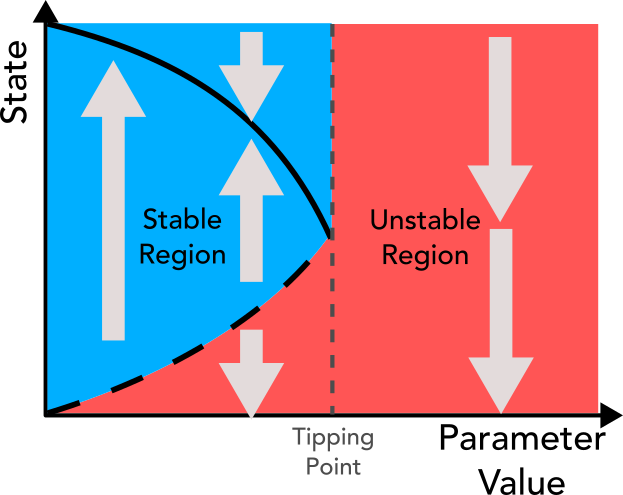
Recall: Bifurcations
Bifurcations are when the qualitative behavior of a system changes across a parameter boundary.
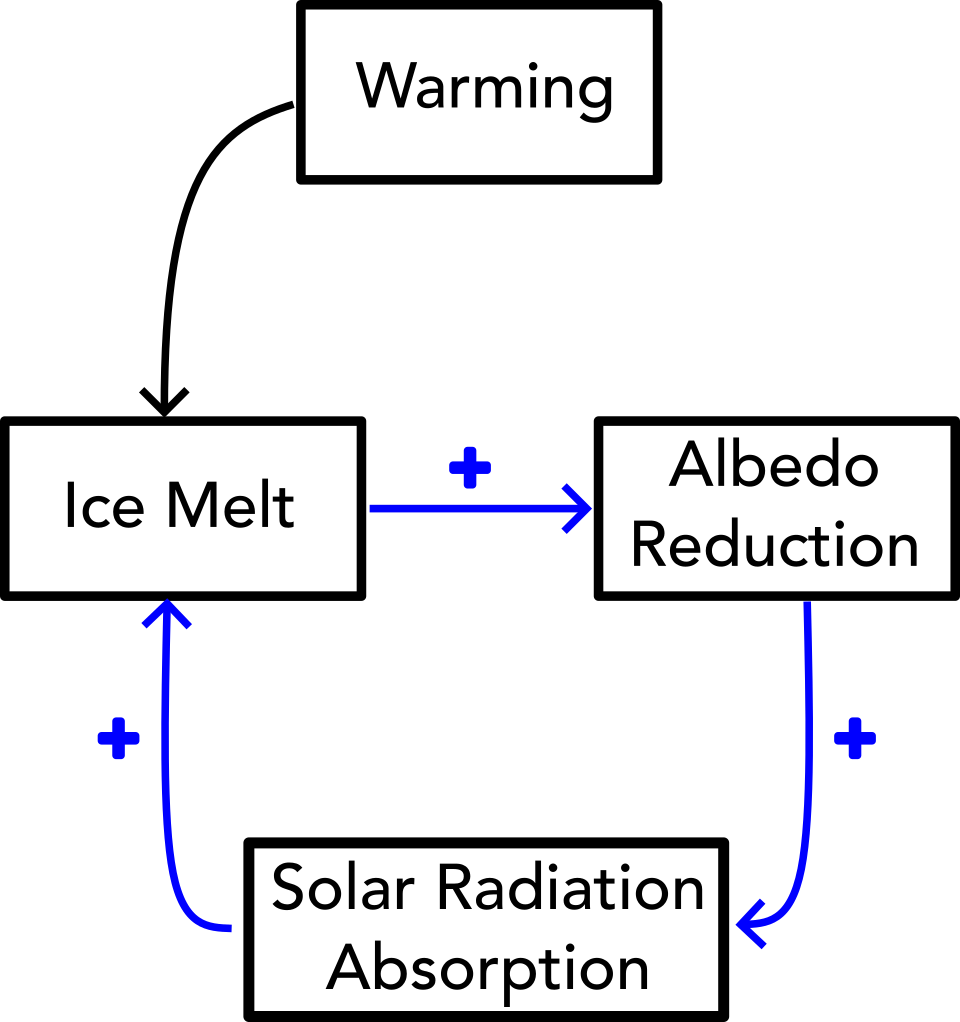
Recall: Feedback Loops
Feedback loops can be reinforcing or dampening.
Dampening feedback loops are associated with stable equilibria, while reinforcing feedback loops are associated with instability.
What Are The Implications of These Dynamics?
- May violate strong geometric constraints from mathematical programming.
- Neglecting can lead to overconfidence about outcomes.
Emergence
- Simple “micro”-scale rules can yield more complex and unexpected “macro”-scale outcomes
- Can complicate writing down system dynamics and constraints in MP form.

Source: Blaqdolphin - Own work, CC BY-SA 4.0, https://commons.wikimedia.org/w/index.php?curid=91228415
Challenge 2: Multiple Objectives
We often have multiple objectives that we want to analyze.
- Costs
- Environmental impacts
- Reliability
Mathematical Programming and Multiple Objectives
We could formulate constraints based on a priori assessments of acceptability:
- Budget constraints;
- Reliability constraints
Combining Multiple Objectives Together
Another common approach is to combine multiple objectives \(Z_i\) together into a weighted sum:
\[\sum_i w_i Z_i,\]
where \(\sum_i w_i = 1\).
This requires normalizing the \(Z_i\).
Limits of These Approaches
Can you think of problems or limits with these approaches to handling multiple objectives?
- Require a priori assessments of acceptable limits and/or weights.
- Limits ability to understand “macro”-scale tradeoffs (beyond shadow prices).
- Can conduct sensitivity analysis on weights to explore tradeoffs but this requires a large number of runs.
- Interpretability: what do weights mean?
Example: Shallow Lake Problem
Shallow Lake Problem
Recall the shallow lake problem from earlier in the semester.
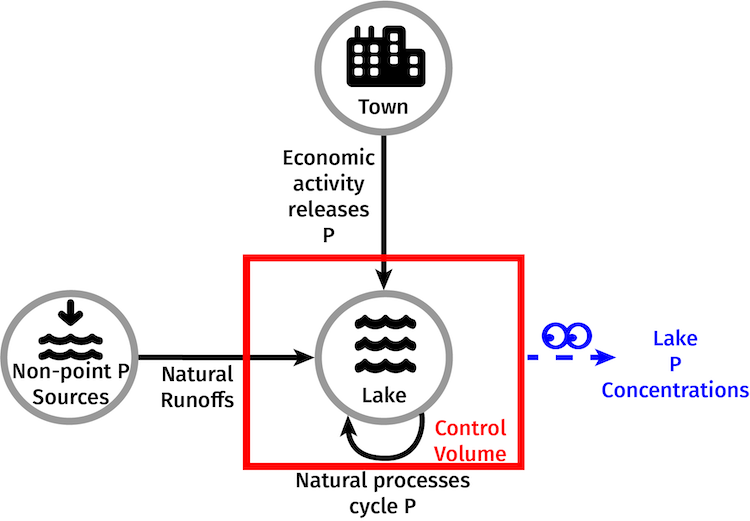
Lake Model
\[\begin{align*} X_{t+1} &= X_t + a_t + y_t \\ &\quad + \frac{X_t^q}{1 + X_t^q} - bX_t,\\[0.5em] y_t &\sim \text{LogNormal}(\mu, \sigma^2) \end{align*}\]
| Parameter | Definition |
|---|---|
| \(X_t\) | P concentration in lake |
| \(a_t\) | point source P input |
| \(y_t\) | non-point source P input |
| \(q\) | P recycling rate |
| \(b\) | rate at which P is lost |
Lake Model Dynamics
GKS: could not find font bold.ttfThe Lake Problem As a Mathematical Program?
What complicates formulating a mathematical program for the lake problem?
The Lake Problem As a Mathematical Program?
Our objective might be to maximize \(\sum_{t=1}^T a_t\) (as a proxy for economic activity), while keeping a low probability of eutrophication.
Means we need to write the probability of eutrophication in closed form.
Uncertain Inputs and MP
How can we represent uncertainty in inputs \(y_t\) in an MP?
- Very challenging to formulate scenarios;
- Non-trivial (if possible) to write expected value in analytic form;
- But Monte Carlo simulation is straightforward…
Multiple Objectives and the Lake Problem
What are some relevant objectives for the lake problem?
- Maximize phosphorous output (proxy for economic output)
- Maximize probability of avoiding eutrophification
- Can add other objectives breaking out lake response (stability, worst case P concentration, etc.)
Upshot Of These Challenges
Many systems problems with
- complex, non-linear dynamics;
- continuous uncertainties;
- multiple objectives.
don’t lend themselves well to mathematical programming.
So how can we make decisions?
Multiple Objectives
Multiple Objectives and Environmental Systems
Often have multiple objectives at play when designing or managing environmental systems:
Some examples:
- Cost
- Environmental quality
- Reliability/Variability
Example: Power Systems
- Total generation cost (including reserves);
- CO2 emissions;
- Resource adequacy (do we have enough resources available);
- Reliability;
- Other environmental impacts
Example: Reservoir Operations
- Municipal demand;
- Irrigation;
- Recreation;
- Hydropower potential;
- Flood management;
- Streamflow (ecosystem management)
How Can We Incorporate Multiple Objectives Into Models?
Approaches are method specific!
Key Question: what does it mean to “optimize” multiple objectives?
How Can We Incorporate Multiple Objectives Into Models?
Linear Programming:
- Identify thresholds and establish constraints for non-objective “objectives”;
- Weight objectives based on preferences, e.g. \[\min_\mathbf{x} Z(\mathbf{x}) = \sum_i w_i \hat{Z_i}(\mathbf{x}), \qquad \sum_i w_i =1\]
- If we don’t have a clear estimate of weights that reflect preferences, can explore implications of many different combinations.
How Can We Incorporate Multiple Objectives Into Models?
Simulation-Optimization:
- Could use the LP approaches
- Can also have the simulation model return multiple metrics
- Then use a method (e.g. a search algorithm, like evolutionary algorithms) to explore objective space
Back To The Key Question…
What does it mean to “optimize” multiple objectives?
Straightforward with weighting, requires but a priori elicitation of weights.
What about if we leave the objectives unaggregated?
Example: Lake Problem
Simulated 100 random decisions with two objectives:
- Maximize mean P releases
- Minimize probability of exceeding critical P concentration
Tradeoffs
There is a tradeoff between these two objectives:
Greater releases typically means lower reliability.
What does it mean to find an “optimum” across these two objectives?
Non-Dominated Decisions
We say that a decision \(\mathbf{x}\) is dominated if there exists another solution \(\mathbf{y}\) such that for every objective metric \(Z_i(\cdot)\), \[Z_i(\mathbf{x}) > Z_i(\mathbf{y}).\]
Non-Dominated Decisions
\(\mathbf{x}\) is non-dominated if it is not dominated by any \(\mathbf{y} \neq \mathbf{x}\).
Pareto Fronts
The set of non-dominated solutions is called the Pareto front (solutions are Pareto-optimal).
Every member of a Pareto front represents a different tradeoff between objectives.
A Priori vs A Posteriori Decision-Making
This gives us two frameworks for evaluating tradeoffs:
- A Priori: Establish weights ahead of time and combine objectives;
- A Posteriori: Identify Pareto-optimal solutions and then discuss what tradeoffs are tolerable.
Identifying Pareto Fronts
In higher dimensions, manually screening of a Pareto front is difficult.
Can use multi-objective optimization with (certain) evolutionary algorithms.
Key Takeaways
Takeaways
- General challenges to mathematical programming for general systems analysis.
- These challenges include:
- Complex and non-linear systems dynamics;
- Uncertainties;
- Multiple objectives.
Multiple Objectives
- Management of environmental systems often involves multiple objectives.
- Multiple objectives often have tradeoffs.
- Can combine multiple objectives with weights (a priori decision-making) or identifying non-dominated solutions (a posteriori decision-making)
- Set of non-dominated solutions (Pareto front) represent different choices about tradeoffs.
Upcoming Schedule
Next Classes
Monday: Robustness and Sensitivity Analysis
Assessments
HW5: Will be due last week of class (12/4).