Useful to compute expected values of quantities (integrals)
Monte Carlo Estimate of \(\mu = \mathbb{E}[Y]\): \[\tilde{\mu}_n = \frac{1}{n}\sum_{i=1}^n f(Y_i)\]
Why Monte Carlo Works
Unbiased estimates (across multiple samples)
Convergence of single sample:
Law of Large Numbers
Monte Carlo Standard Error
Standard error: \(\sigma_Y / \sqrt{n} \approx \tilde{\sigma}_{\hat{Y}_n} / \sqrt{n}\)
Central Limit Theorem: \[\tilde{\mu}_n - \mu \sim \mathcal{N}\left(0, \frac{\sigma_Y^2}{n}\right)\]
Monte Carlo Confidence Intervals
Construct CIs using this normal approximation: \[\tilde{\mu}_n \pm \Phi^{-1}\left(1 - \frac{\alpha}{2}\right) \frac{\sigma_Y}{\sqrt{n}}.\] For example, the 95% confidence interval is \[\tilde{\mu}_n \pm 1.96 \frac{\sigma_Y}{\sqrt{n}}.\]
CI Interpretation: Mean of \(N(0.4, 2)\)
Code
# set up distributionmean_true =0.4n_cis =100# number of CIs to computedist =Normal(mean_true, 2)# use sample size of 100samples =rand(dist, (100, n_cis))# mapslices broadcasts over a matrix dimension, could also use a loopsample_means =mapslices(mean, samples; dims=1)sample_sd =mapslices(std, samples; dims=1) mc_sd =1.96* sample_sd /sqrt(100)mc_ci =zeros(n_cis, 2) # preallocatefor i =1:n_cis mc_ci[i, 1] = sample_means[i] - mc_sd[i] mc_ci[i, 2] = sample_means[i] + mc_sd[i]end# find which CIs contain the true valueci_true = (mc_ci[:, 1] .< mean_true) .&& (mc_ci[:, 2] .> mean_true)# compute percentage of CIs which contain the true valueci_frac1 =100*sum(ci_true) ./ n_cis# plot CIsp1 =plot([mc_ci[1, :]], [1, 1], linewidth=3, color=:deepskyblue, label="95% Confidence Interval", title="Sample Size 100", yticks=:false, legend=:false)for i =2:n_cisif ci_true[i]plot!(p1, [mc_ci[i, :]], [i, i], linewidth=2, color=:deepskyblue, label=:false)elseplot!(p1, [mc_ci[i, :]], [i, i], linewidth=2, color=:red, label=:false)endendvline!(p1, [mean_true], color=:black, linewidth=2, linestyle=:dash, label="True Value") # plot true value as a vertical linexaxis!(p1, "Estimate")plot!(p1, size=(500, 500)) # resize to fit slide# use sample size of 1000samples =rand(dist, (1000, n_cis))# mapslices broadcasts over a matrix dimension, could also use a loopsample_means =mapslices(mean, samples; dims=1)sample_sd =mapslices(std, samples; dims=1) mc_sd =1.96* sample_sd /sqrt(1000)mc_ci =zeros(n_cis, 2) # preallocatefor i =1:n_cis mc_ci[i, 1] = sample_means[i] - mc_sd[i] mc_ci[i, 2] = sample_means[i] + mc_sd[i]end# find which CIs contain the true valueci_true = (mc_ci[:, 1] .< mean_true) .&& (mc_ci[:, 2] .> mean_true)# compute percentage of CIs which contain the true valueci_frac2 =100*sum(ci_true) ./ n_cis# plot CIsp2 =plot([mc_ci[1, :]], [1, 1], linewidth=3, color=:deepskyblue, label="95% Confidence Interval", title="Sample Size 1,000", yticks=:false, legend=:false)for i =2:n_cisif ci_true[i]plot!(p2, [mc_ci[i, :]], [i, i], linewidth=2, color=:deepskyblue, label=:false)elseplot!(p2, [mc_ci[i, :]], [i, i], linewidth=2, color=:red, label=:false)endendvline!(p2, [mean_true], color=:black, linewidth=2, linestyle=:dash, label="True Value") # plot true value as a vertical linexaxis!(p2, "Estimate")plot!(p2, size=(500, 500)) # resize to fit slidedisplay(p1)display(p2)
If we want to design a treatment strategy, we are now in the world of prescriptive modeling.
Recall: Precriptive modeling is intended to specify an action, policy, or decision.
Descriptive modeling question: “What happens if I do something?”
Prescriptive modeling question: “What should I do?”
Decision Models
To make a decision, we need certain pieces of information which:
define decision options (or alternatives);
provide one or more objectives to assess performance;
specify constraints to tell us what decisions are possible or acceptable.
Be Careful…
The optimal solution of a model is not an optimal solution of a problem unless the model is a perfect representation of the problem, which it never is.
— Ackoff, R. L. (1979). “The Future of Operational Research is Past.” The Journal of the Operational Research Society, 30(2), 93–104. https://doi.org/10.1057/jors.1979.22
Objectives
Typical objectives can include:
Minimizing costs (or maximizing profits);
Minimizing environmental impacts;
Maximizing some other performance metric.
Approaches to Optimization
Generalized Search Algorithms
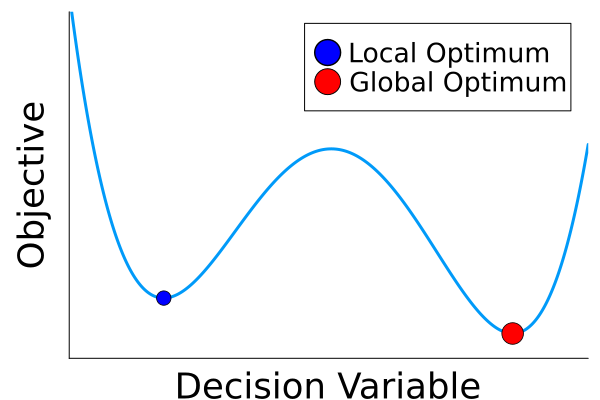
Function with Multiple Minima
Most search algorithms look for critical points to find candidate optima. Then the “best” of the critical points is the global optimum.
Generalized Search Algorithms
Function with Multiple Minima
Two common approaches:
Gradient-based methods
Evolutionary algorithms
Gradient Descent
Find estimate of gradient near current point and step in positive/negative direction (depending on max/min).
\[x_{n+1} = x_n \pm \alpha_n \nabla f(x_n)\]
Gradient Descent: Challenges
Need to tune stepsize for convergence; some use adaptive methods;
May not have information about the gradient.
The second is more problematic: in some cases, methods like stochastic gradient approximation or automatic differentiation can be used.
“Random” Search
Use a sampling strategy to find a new proposal, then evaluate, keep if improvement.
Evolutionary Algorithms fall into this category.
Random Search with Constraints
Can also incorporate constraints into search.
Drawbacks of Search Algorithms
These methods work pretty well, but can:
require a lot of evaluations;
may get stuck at local optima;
may not converge if step sizes aren’t set correctly
waiting model evaluation meme
Generalized Search Algorithms
These methods work pretty well, but can:
require a lot of evaluations;
may get stuck at local optima;
may not converge if step sizes aren’t set correctly
waiting model evaluation meme
Generalized Search Algorithms
These methods work pretty well, but can:
require a lot of evaluations;
may get stuck at local optima;
may not converge if not tuned well.
waiting model evaluation meme
Mathematical Programming
It can be convenient (and sometimes appropriate!) to formulate problems where we can guarantee finding a solution is a reasonable amount of time.
These approaches are called mathematical programs.
We will spend the next few weeks talking about linear programming and its variants.
Key Takeaways
Prescriptive Modeling
Prescriptive modeling involves decision models.
Key components of a decision model:
Decision Variables;
Objectives;
Constraints.
Need to bring to bear relevant engineering, economic, and environmental information to formulate these.
Approaches to Optimization
General approaches can be computationally expensive or we may not be able to guarantee convergence.
An alternative is mathematical programming: can often guarantee ability to find solutions but at the expense of needing very specific problem formulations.
Upcoming Schedule
Next Classes
Wednesday: Prelim 1, does not include material from today’s lecture.