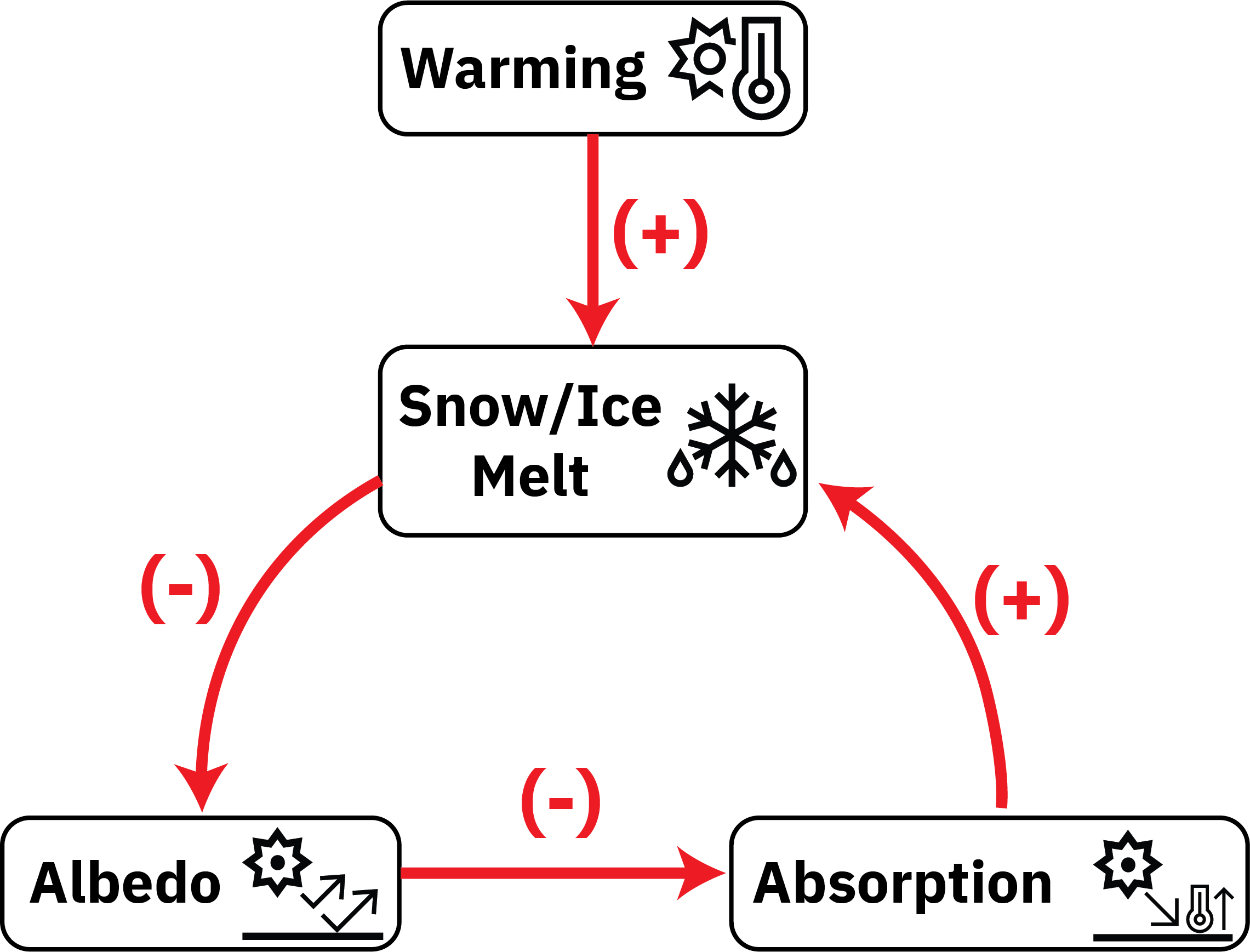
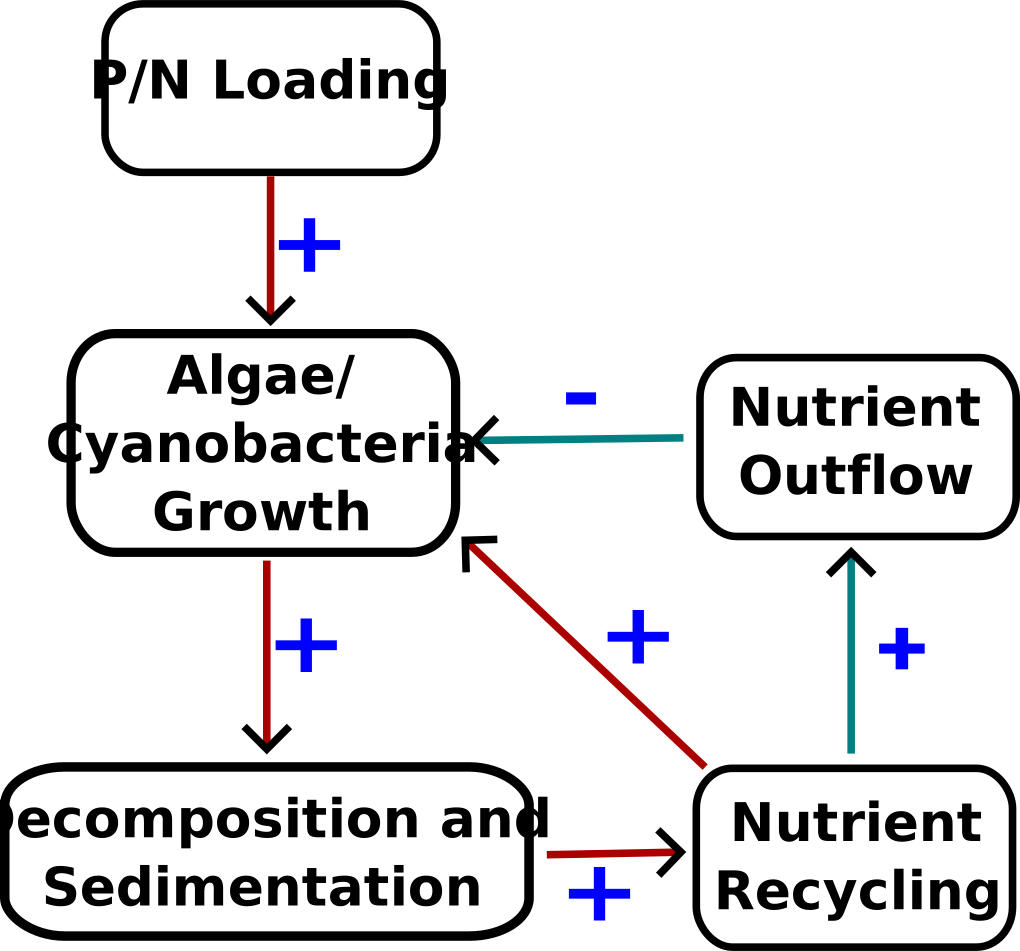
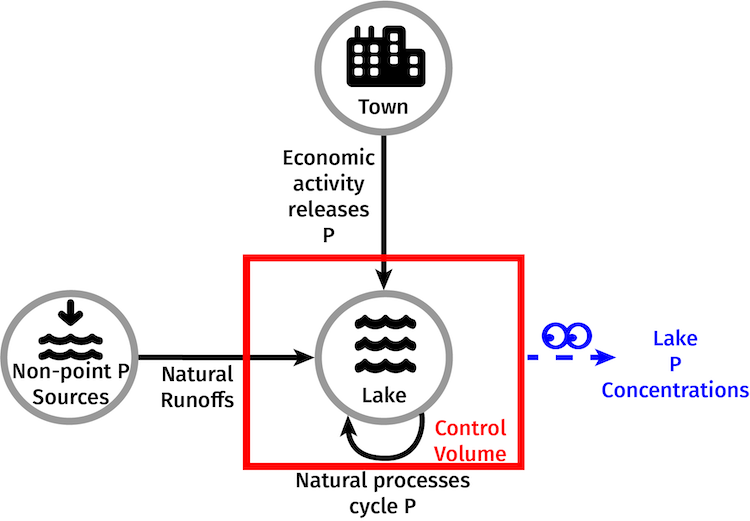
Tradeoff between economic benefits and the health of the lake.
Lake Eutrophication Example
Shallow Lake Model: Variables
Variable
Meaning
Units
\(X_t\)
P level in lake at time \(t\)
dimensionless
\(a_t\)
Controllable (point-source) P release
dimensionless
\(y_t\)
Random (non-point-source) P runoff
dimensionless
Shallow Lake Model: Runoff
Random runoffs \(y_t\) are sampled from a LogNormal distribution.
Code
# this uses StatsPlots.jl's recipe for plotting distributions directly; otherwise use something like plot(-5:0.01:5, pdf.(LogNormal(0.25, 1), -5:0.1:5))plot(LogNormal(0.25, 1), linewidth=3, label="LogNormal(0.25, 1)")plot!(LogNormal(0.5, 1), linewidth=3, label="LogNormal(0.5, 2)")plot!(LogNormal(0.25, 2), linewidth=3, label="LogNormal(0.25, 2)")plot!(size=(1000, 400), grid=:false, left_margin=10mm, right_margin=10mm, bottom_margin=10mm)xlims!((0, 6))ylabel!("Density")xlabel!(L"y_t")
Figure 3: Lognormal Distributions
Shallow Lake Model: P Dynamics
Lake loses P at a linear rate, \(bX_t\).
Nutrient cycling reintroduces P from sediment: \[\frac{X_t^q}{1 + X_t^q}.\]
Shallow Lake Model
So the P level (state) \(X_{t+1}\) is given by: \[\begin{gather*}
X_{t+1} = X_t + a_t + y_t + \frac{X_t^q}{1 + X_t^q} - bX_t, \\[0.5em]
y_t \underset{\underset{\Large\text{\color{red}sample}}{\color{red}\uparrow}}{\sim} \text{LogNormal}(\mu, \sigma^2).
\end{gather*}
\]
Equilibria and Bifurcations
Lake Dynamics (Without Inflows)
\(a_t = y_t = 0\),
\(q=2.5\)
\(b=0.4\)
Code
# define functions for lake recycling and outflowslake_P_cycling(x, q) = x.^q ./ (1.+ x.^q);lake_P_out(x, b) = b .* x;T =30X_vals =collect(0.0:0.1:2.5)functionsimulate_lake_P(X_ic, T, b, q, a, y) X =zeros(T) X[1] = X_icfor t =2:T X[t] = X[t-1] .+ a[t] .+ y[t].+lake_P_cycling(X[t-1], q) .-lake_P_out(X[t-1], b)endreturn XendX =map(x ->simulate_lake_P(x, T, 0.4, 2.5, zeros(T), zeros(T)), X_vals)p_noinflow =plot(X, label=false, ylabel=L"X_t", xlabel="Time", size=(600, 500))
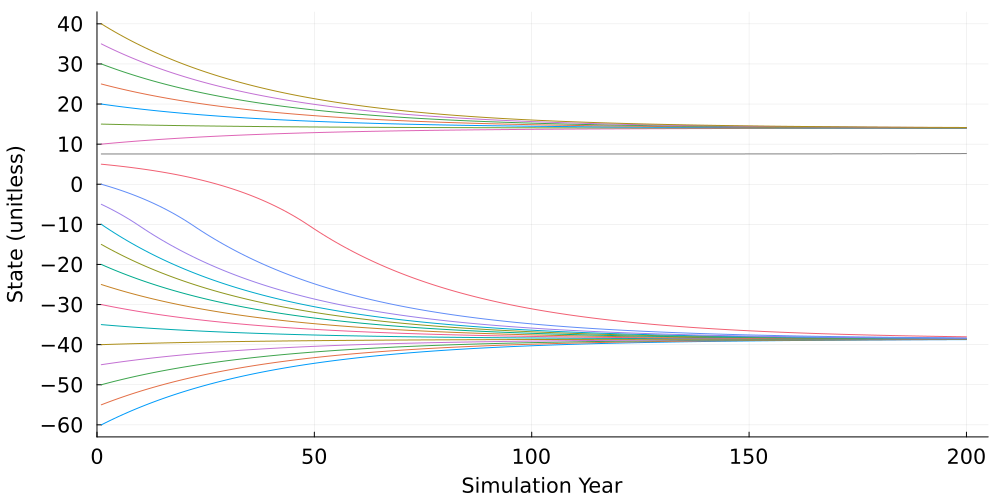
Figure 4: Dynamics of lake model with different initial conditions
Lake Dynamics (Without Inflows)
\(a_t = y_t = 0\),
\(q=2.5\)
\(b=0.4\)
Code
# define range of lake states Xx =0:0.05:2.5;# plot recycling and outflows for selected values of b and qp1 =plot(x, lake_P_cycling(x, 2.5), color=:black, linewidth=5,legend=:topleft, label="P Recycling", ylabel="P Flux", xlabel=L"$X_t$", palette=:tol_muted, framestyle=:zerolines, grid=:false)plot!(x, lake_P_out(x, 0.4), linewidth=3, linestyle=:dash, label="b=0.4", color=:blue)quiver!([1], [0.35], quiver=([1], [0.4]), color=:red, linewidth=2)quiver!([0.4], [0.13], quiver=([-0.125], [-0.05]), color=:red, linewidth=2)quiver!([2.5], [0.97], quiver=([-0.125], [-0.05]), color=:red, linewidth=2)plot!(ylims=(-0.02, 1.1))plot!(size=(600, 500))
Figure 5: Lake eutrophication dynamics based on the shallow lake modelwithout additional inputs. The black line is the P recycling level (for $q=2.5), which adds P back into the lake, and the dashed lines correspond to differerent rates of P outflow (based on the linear parameter \(b\)). The lake P level is in equilibrium when the recycling rate equals the outflows. When the outflow is greater than the recycling flux, the lake’s P level decreases, and when the recycling flux is greater than the outflow, the P level naturally increases. The red lines show the direction of this net flux.
Where Are the Equilibria?
Equilibria: Fixed points of the dynamics (no state change).
Equilibria occur where \[\Delta X = X_{t+1} - X_t = 0,\] so the outflows and sediment recycling are in balance.
Figure 6: Lake eutrophication dynamics based on the shallow lake modelwithout additional inputs. The black line is the P recycling level (for \(q=2.5\)), which adds P back into the lake, and the dashed lines correspond to differerent rates of P outflow (based on the linear parameter \(b\)). The lake P level is in equilibrium when the recycling rate equals the outflows. When the outflow is greater than the recycling flux, the lake’s P level decreases, and when the recycling flux is greater than the outflow, the P level naturally increases. The red lines show the direction of this net flux.
Stability of Equilibria
Consider a discrete system model \(X_{t+1} = F(X_t)\) (continuous: \(\frac{dx}{dt} = f(x)\)).
An equilibrium \(X^*\) is stable if nearby points are attracted to it (small perturbations “recover”): \(|F'(X^*)| < 1\) or \(f'(X^*) < 0\)
\(X^*\) is unstable if nearby points are repelled by it: \(|F'(X^*)| > 1\) or \(f'(X^*) > 0\)
Stability and Resilience
Can think of stable equilibria as suggesting “resilience”: small disruptions to the system state will fade away with time and the system will stabilize.
Unstable equilibria: small shocks amplify and the system will deviate from its “typical” state.
Implications of Unstable Equilibria
Code
plot!(p_noinflow, title="Lake P Without Inflows", titlefontsize=20)
Figure 7: Dynamics of Lake Model With No Inflows
Code
a =zeros(T)y =rand(LogNormal(log(0.08), 0.01), T)X =map(x ->simulate_lake_P(x, T, 0.4, 2.5, a, y), X_vals) plot(X, label=false, ylabel=L"$X_t$", xlabel="Time", title="Lake P With Inflows", size=(600, 500))
Figure 8: Dynamics of Lake Model With No Inflows
How do Equilibria Change?
How do the equilibria change as system parameters vary?
Figure 9: Lake eutrophication dynamics based on the shallow lake modelwithout additional inputs. The black line is the P recycling level (for \(q=2.5\)), which adds P back into the lake, and the dashed lines correspond to differerent rates of P outflow (based on the linear parameter \(b\)). The lake P level is in equilibrium when the recycling rate equals the outflows. When the outflow is greater than the recycling flux, the lake’s P level decreases, and when the recycling flux is greater than the outflow, the P level naturally increases. The red lines show the direction of this net flux.
Figure 10: Bifurcation diagram for the lake problem with no inputs.
Implications of Bifurcations
Bifurcations have the following implications:
Uncertainty about system dynamics can dramatically change equilibria locations and behavior;
“Shocks” (in this case, sedimentation/recycling disturbances or massive non-point source inflows) can irreversibly alter system outcomes.
Key Takeaways
Key Takeaways (Equilibria)
System equilibria states can be stable or unstable.
Unstable equilbria can be responsible for thresholds/tipping points.
Bifurcations: Changes to number/qualitative behavior of equilibria as system properties vary.
Upcoming Schedule
Next Classes
Next Week: Simulation Models
Assessments
Homework 1: Due 9/11 at 9pm
References
References
Carpenter, S. R., Ludwig, D., & Brock, W. A. (1999). Management of eutrophication for lakes subject to potentially irreversible change. Ecol. Appl., 9(3), 751–771. https://doi.org/10.2307/2641327
Quinn, J. D., Reed, P. M., & Keller, K. (2017). Direct policy search for robust multi-objective management of deeply uncertain socio-ecological tipping points. Environmental Modelling & Software, 92, 125–141. https://doi.org/10.1016/j.envsoft.2017.02.017